FNA-based immune profiling of tumor microenvironment
Franzén B, Viktorsson K, Kamali C, Darai-Ramqvist E, Grozman V, Hååg P, Nyrén S, Kaminskyy VO, Hydbring P, Kanter L, Ekman S, De Petris L,
Alexeyenko A, Kamali-Moghaddam M, Hatschek T, Ramqvist T, Kierkegaard J, Masucci G, Auer G, Landegren U and R. Lewensohn
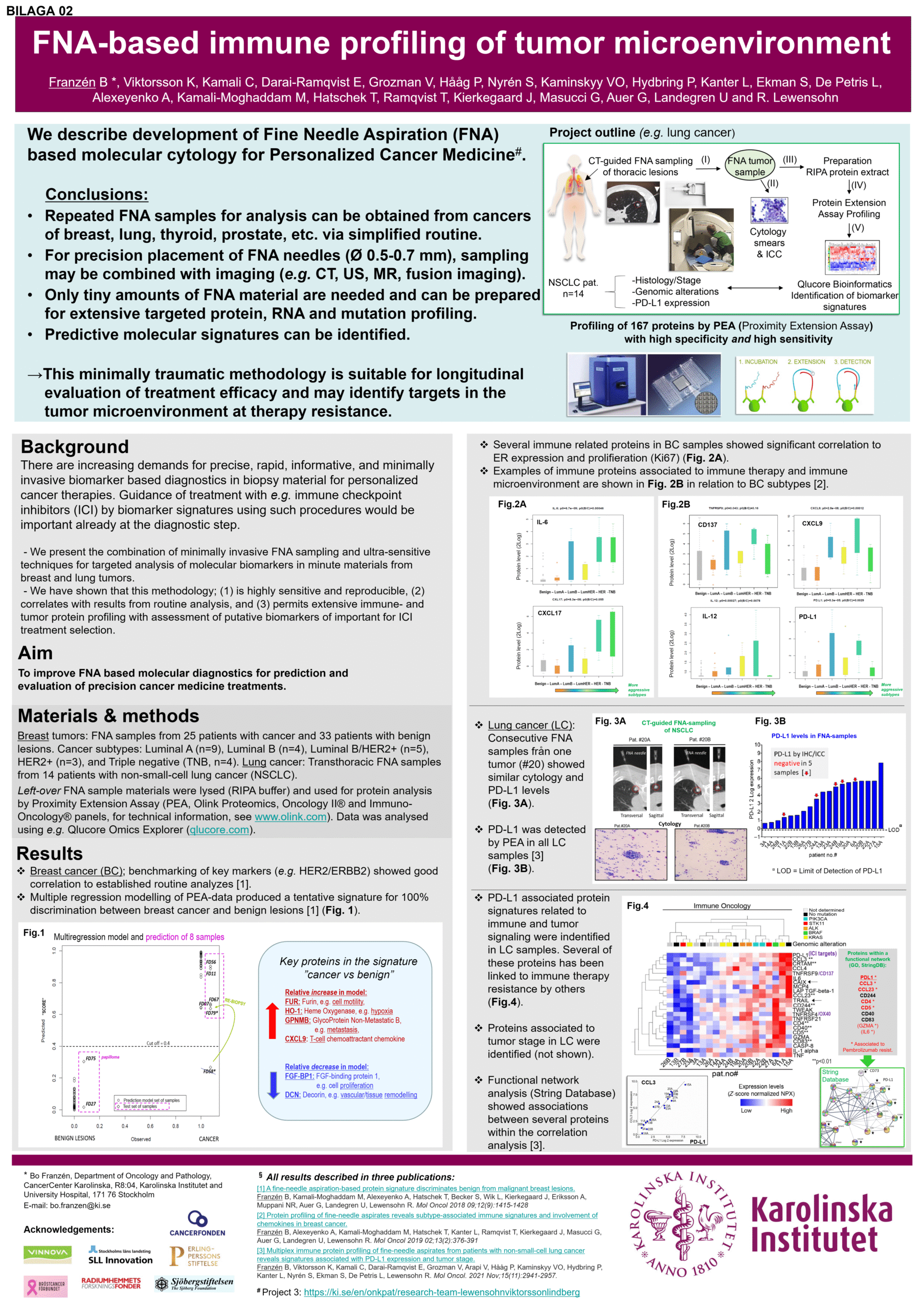
This scientific poster was presented at the Karolinska Comprehensive Cancer Centre days, 30th-31st of March 2023 and at the 6th Swedish Cancer Research Meeting, 16-17th May 2023 (Aula Medica, Karolinska Institutet). It shows our development and application of Fine Needle Aspiration (FNA)-based molecular cytology for personalized cancer medicine, particularly focusing on breast cancer (BC) and non-small-cell lung cancer (NSCLC).
Tissue to Insight in Minutes
Ultra-Minimal Sampling, Maximum Molecular Information: The method uses minimally invasive Fine Needle Aspiration (FNA), often guided by imaging, to collect small samples suitable for extensive molecular profiling from various solid cancers and metastases.
Tiny Samples, Big Data
Ultra-Sensitive Profiling Meets Clinical Accuracy: Combining FNA with ultra-sensitive techniques like Proximity Extension Assay (PEA) provides highly sensitive, reproducible molecular results that correlate well with established routine clinical analyses.
Perfect Separation at Scale
The technique allows for the identification of predictive molecular signatures, such as a multi-regression model that achieved 100% discrimination between breast cancer and benign lesions.
Unlocking the Immune Checkpoint Code
The technique enables extensive profiling of the immune and tumor microenvironment by identifying proteins like PD-L1 and associated signatures relevant for immune checkpoint inhibitor (ICI) treatment selection and resistance.
One Thin Needle for Continuous Monitoring
Tracking Treatment Response and Resistance in Real Time: This minimally traumatic methodology is suitable for longitudinal evaluation of treatment efficacy and has the potential to monitor therapy resistance in the tumor microenvironment.